Pick up a bag of specialty coffee and you may see the words washed, honey, or natural on the label. Those words describe what happened to the coffee after the fruit was picked and before the beans were dried, shipped, and roasted.
That part of the journey matters. Processing can influence sweetness, fruit character, clarity, body, and even how a coffee feels as you drink it.
Good coffee is like a good wine, with elements of sweetness, fruit and other attributes, body, balance and acidity. Remember that acid and acidity are two different things when it comes to coffee. Acidity is referred to as brightness like a white wine or when you bite into an apple.
Acid is what most people do not like about coffee, but not coffee in general. Acid can be quite high in darker roasts, this is known as quinic acid and is a byproduct of roasting. So, when your tummy hurts after a cuppa or you must add cream to avoid the reflux, know it's not acidity rather acid. Time to drink a better coffee! If good coffee has the same effect, my bet is you are sensitive to caffeine which acts as a stimulant and can irritate the stomach.
Here is the plain-language version.
First, coffee is the seed of a fruit
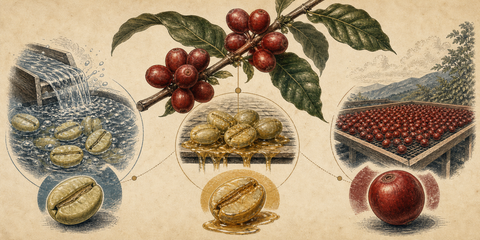
The coffee beans we roast begin as seeds inside coffee cherries. When those cherries are ripe, the cherry is picked from the tree, and the producers have to remove the fruit and dry the seeds to a stable moisture level.
The timing and method of removing that fruit is what separates washed, honey, and natural coffees.
Each process requires careful work. A great result depends on ripe fruit, good fermentation, even drying, clean equipment, weather, and close attention from the producer. The name of the process gives us a useful clue, although it cannot tell us exactly what the finished cup will taste like.
Washed coffee

In a washed process, the outer skin and most of the fruit are removed soon after picking. The coffee is then fermented and washed to clear away the remaining sticky layer before the seeds are dried.
Washed coffees often taste clean and clearly defined. Individual notes can be easier to pick out, and the acidity may feel bright or structured. If a coffee reminds you of flowers, tea, or a crisp piece of fruit, careful washed processing may be part of the reason.
I often describe a good, washed coffee as articulate. You can hear the individual instruments.
Honey-process coffee
Despite the name, no honey is added.
With the honey process, the skin is removed while some of the coffee fruit’s sticky mucilage remains on the seed during drying. This is referred to as the 'honey'. Producers can leave different amounts of that material in place and manage the drying in different ways.

Honey coffees often land somewhere between the clarity of a washed coffee and the fuller fruit character of a natural. They can show round sweetness, a little more body, and flavors that remind people of caramel, jam, or ripe fruit.
The process takes real care. Coffee drying with mucilage still attached needs to be turned and monitored so it dries evenly and stays clean.
Natural coffee
In a natural process, the coffee cherries are dried with the fruit still surrounding the seeds. Once the cherries are fully dried, the fruit is removed.

Because the seed spends much more time with the fruit, natural coffees can develop a bigger fruit presence, heavier body, and more fermented character. You may find notes that remind you of berries, tropical fruit, wine, or chocolate.
Natural processing can produce wonderfully expressive coffee. It also leaves less room for sloppy work. Uneven drying or poor fermentation can create distracting flavors and over-fermented flavor, so the best natural coffees reflect a great deal of sorting, patience, and control.
Beyond the big three
Washed, honey, and natural are the three broad processing families you will encounter most often. Within those families, producers can adjust how much fruit remains, how long the coffee ferments, whether oxygen is present, and how the coffee is dried.
White, yellow, red, and black honey. These are variations within the honey-process family. The names generally reflect differences in how much mucilage remains and how the coffee is dried whether it is full sun, full shade or partial of each. Sometimes farmers will place the coffee in a hoop house or similar and/or cover it with netting to reduce or control the amount of light and air flow. Black honey usually requires particularly careful, slower drying and can produce a heavier, sweeter, more fruit-driven cup.
Pulped natural. This method is most common in Brazil. The cherry skin is removed, but some fruit material remains while the coffee dries. It overlaps considerably with what many producers call honey processing.
Anaerobic fermentation. Coffee ferments in a sealed or low-oxygen environment before drying or washing. It can be paired with a natural, honey, or washed process—which is why you may see a term such as “anaerobic natural” on a coffee bag.
Carbonic maceration. Borrowed in part from winemaking, this technique places whole cherries in a sealed, carbon-dioxide-rich environment. It is a fermentation method rather than a completely separate processing family.
Extended or inoculated fermentation. Producers may extend fermentation time or introduce selected yeasts and microorganisms to influence how fermentation develops. These techniques can also be combined with washed, honey, or natural processing.
Wet-hulled. Commonly associated with Indonesia, namely Sumatra and also called giling basah, wet-hulled coffee has its parchment removed while the coffee still contains considerably more moisture than fully dried green coffee. It is the main reason these coffees develop and earthy or 'forest floor' character. This is because the parchment that protects coffee during drying for other processes is removed and since the coffee is still wet, it's drying without any protective parchment, picking up taints from the environment.
The name on the bag is useful—but it rarely tells the entire story.
At a glance
| Process | What dries | Common cup tendencies |
|---|---|---|
| Washed | Coffee seed after most fruit is removed | Clean, bright, clearly defined |
| Honey | Coffee seed with some mucilage attached | Round sweetness, body, ripe fruit |
| Natural | Whole coffee cherry | Bold fruit, fuller texture, fermented character |
Does processing determine the flavor?
It influences the flavor, but it is only one part of the story.
Country, region, coffee variety, elevation, soil, harvest conditions, fermentation, drying, storage, roasting, and brewing all contribute to the cup. Two natural coffees can taste completely different. A washed coffee can be deeply sweet, and a natural coffee can be surprisingly clean.
Use the process as a starting point rather than a promise.
Which process should you choose?
If you enjoy a clean cup with clearly separated flavors, start with a washed coffee.
If you like sweetness and body while keeping some clarity, try a honey-process coffee.
If you enjoy bold fruit, fuller texture, or something a little more adventurous, look at the naturals.
Your own palate gets the final vote. Try coffees from more than one category, let them cool as you drink them, and notice what keeps pulling you back for another sip.
That is the useful part of knowing the process. It gives you a better way to describe what you like and makes choosing your next bag a little easier. And drink it black or you will likely never experience the uniqueness of these coffees.
– Tony
Taste the difference
Processing is only one part of a coffee’s flavor. Comparing coffees is one of the best ways to understand what washed, honey, and natural can mean in the cup.

Washed
Guatemala Santa Ines
A clean, clearly defined washed coffee with honey, stone fruit, and chocolate notes.
Explore this coffee →
Honey
El Salvador El Guayabo Honey
Rounded sweetness and body from Jaime Ortiz’s farm near the Santa Ana volcano.
Explore this coffee →
Natural
Peru Jaén Marin Family Coffee
A fruit-forward natural with delicate florals, ripe blackberry, and sweet cherry.
Explore this coffee →Process is a useful starting point, not a promise. Variety, origin, fermentation, roasting, and brewing still matter.
Coffee with Tony · Learn your coffee
Ready to taste it?
Use what you have learned about roast, flavor, and processing to find a whole-bean coffee that sounds right for you.
— Tony